
Research Focus / Projects
Research Focus
The Behavioral Design Laboratory studies and designs human–human interaction in real-world settings. We combine applied behavior analysis, single-case experimental designs, psychological experiments, and interactive technologies to observe, measure, and redesign social interaction.
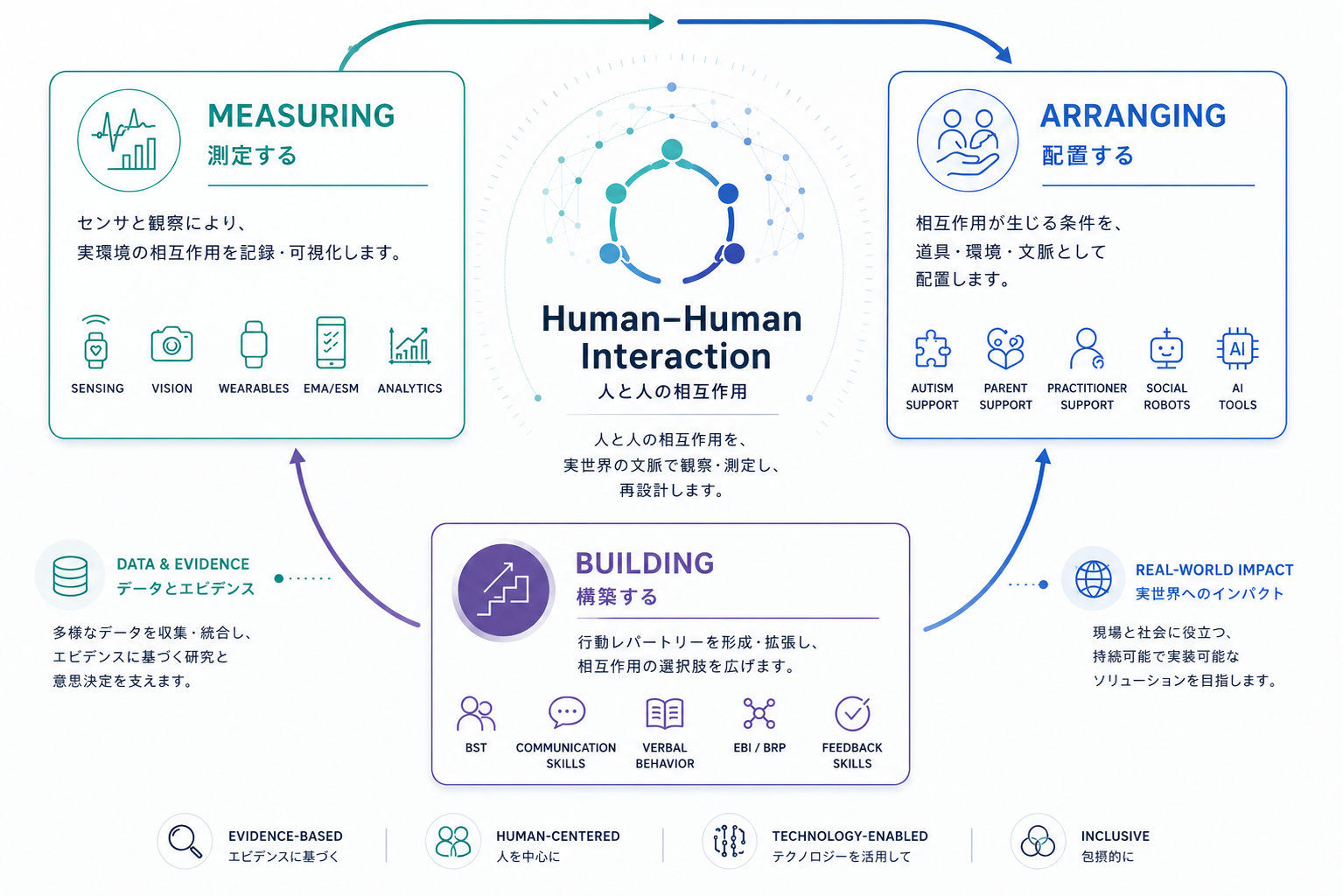
Our work is organized around three connected operations:
- Measuring interaction: recording, visualizing, and quantifying interaction in real-world contexts
- Arranging conditions: configuring tools, environments, and contingencies in which interaction occurs
- Building repertoires: establishing and expanding behavioral repertoires that participate in interaction
These operations are reflected across our research on autism support, social interaction, and verbal behavior.
1) Human Interaction in Autism Support
We design and evaluate technology-enhanced behavioral support for children with autism spectrum disorder (ASD), their families, and practitioners.
This line of work combines behavioral observation, single-case experimental designs, and interactive technologies such as wearables, computer vision, socially assistive robots, motion capture, and smart clothing.
Selected lines of work
- Mechanisms of contingent imitation via acoustic analysis
- Wearable-based feedback to increase social engagement
- Measuring self-injurious behavior with accelerometers
- Remote parent support using a behavioral observation app
- Quantifying classroom social interaction with computer vision
- Interfaces for gaze visualization to assess social communication
- Facilitating social play with paired robotic devices
- Capturing & augmenting face-to-face behavior using wearables
- Monitoring sleep HRV with smart clothing
- Modeling therapist–child interpersonal distance via motion capture
2) Human Interaction in Conversation and Communication
We study and design behavioral systems for dyadic interaction, including conversation, feedback, interviews, video calls, and social communication.
This line of work focuses on how interaction patterns can be observed, trained, and redesigned in real-world social settings.
Selected lines of work
- Effects of supervisor training on 1-on-1 meetings in organizations
- Impact of face visibility on response behavior among individuals with a history of selective mutism
- Behavioral skills training (BST) for simulated job interviews
- BST targeting how people receive feedback
- Effects of face visibility in video calls on task engagement
- Discriminative function of others’ approach/avoidance as a consequence of visual fixation
3) Human Interaction Through Verbal Behavior
We study verbal behavior, language learning, and derived stimulus relations as behavioral processes that shape human interaction.
Building on behavior-analytic approaches to language and learning, this line of work examines how language acquires new functions, generalizes across contexts, and participates in everyday social behavior.
Selected lines of work
- Comparing learning conditions for untrained stimulus relations in foreign-vocabulary acquisition
- Effects of rehearsal and articulatory suppression on language learning
- Experience Sampling Method (ESM) predictors of daily well-being
- Equivalence-based instruction (EBI) for learning statistical hypothesis testing
- Exploring gender stereotypes with the Implicit Relational Assessment Procedure (IRAP)
- Developing the Japanese version of the Evasive Attitudes of Sexual Orientation Scale
Methods and Tools
Across projects, we use:
- Applied behavior analysis
- Single-case experimental designs
- Psychological experiments
- Experience sampling methods
- Behavioral skills training
- Computer vision
- Wearable devices and smart clothing
- Socially assistive robots
- Motion capture
- Remote and parent-mediated support systems
- Open and reproducible research workflows